
How to Legally Form Your Business: A Founder's Step-by-Step Checklist
Filing with the state is the legal 'birth' of your company. But it is only the beginning of building a business that is ready to operate, raise money, sign contracts, and grow.
You chose an LLC or corporation. Great. The next question is whether the company is actually set up to work. A state filing creates the entity, but the decisions around ownership, governance, taxes, banking, and intellectual property are what turn that entity into an operating business.

1. Before You File: Choose the State, Name, and Registered Agent
Decide where the entity should be formed before you click submit. For many owner-operated businesses, the state where the business actually operates may be the simplest choice. For venture-backed startups, a Delaware C-Corp is common, but Delaware is not automatically right for every founder.
If you form in one state but operate in another, you may also need to register there as a foreign entity. You will also need an available business name and, in most states, a registered agent to receive service of process and official notices. Choose the agent before filing because that information is usually required on the formation document.

2. File the Formation Document - Your Company's 'Birth Certificate'
The document name varies by state and entity: Articles of Organization, Certificate of Formation, Articles of Incorporation, or Certificate of Incorporation are common examples. Once the filing is accepted and effective, the company legally exists under the law of its formation state.
But the filing usually contains only basic public-facing information. It does not, by itself, settle who owns what, who controls the company, or what happens if a founder leaves.
3. Build the Rulebook - and Document Founder Ownership
This is the part founders are most tempted to skip. For an LLC, the core internal document is usually an operating agreement. For a corporation, the governance package typically includes bylaws and organizational approvals. These documents should answer practical questions before they become disputes:
• Who owns the company, and in what percentages?
• Who manages the company and which decisions require consent?
• What happens if a founder leaves or wants to transfer equity?
• How are additional contributions, distributions, and deadlocks handled?
Formation also does not automatically issue founder equity. Stock or LLC interests should be properly documented and reflected in clean ownership records. If the business depends on code, designs, trademarks, content, inventions, or other IP created before formation, make sure the company actually owns those assets.


4. Get the EIN, Check Licenses, and Open the Bank Account
After formation, most businesses will need an Employer Identification Number (EIN) from the IRS. Depending on the business and location, you may also need state or local tax registrations, licenses, permits, or foreign qualification before operating.
Then open a dedicated business bank account and keep business and personal money separate. Banks may request formation documents, the EIN, identification, and governance or ownership records. Clean finances make bookkeeping easier now and diligence much easier later.

5. Put Compliance on the Calendar
Formation is an event; compliance is ongoing. Track annual or biennial reports, franchise taxes, license renewals, registered-agent updates, tax filings, and other recurring obligations. Small housekeeping gaps can become large problems when a bank, investor, or buyer asks for clean records or a certificate of good standing.
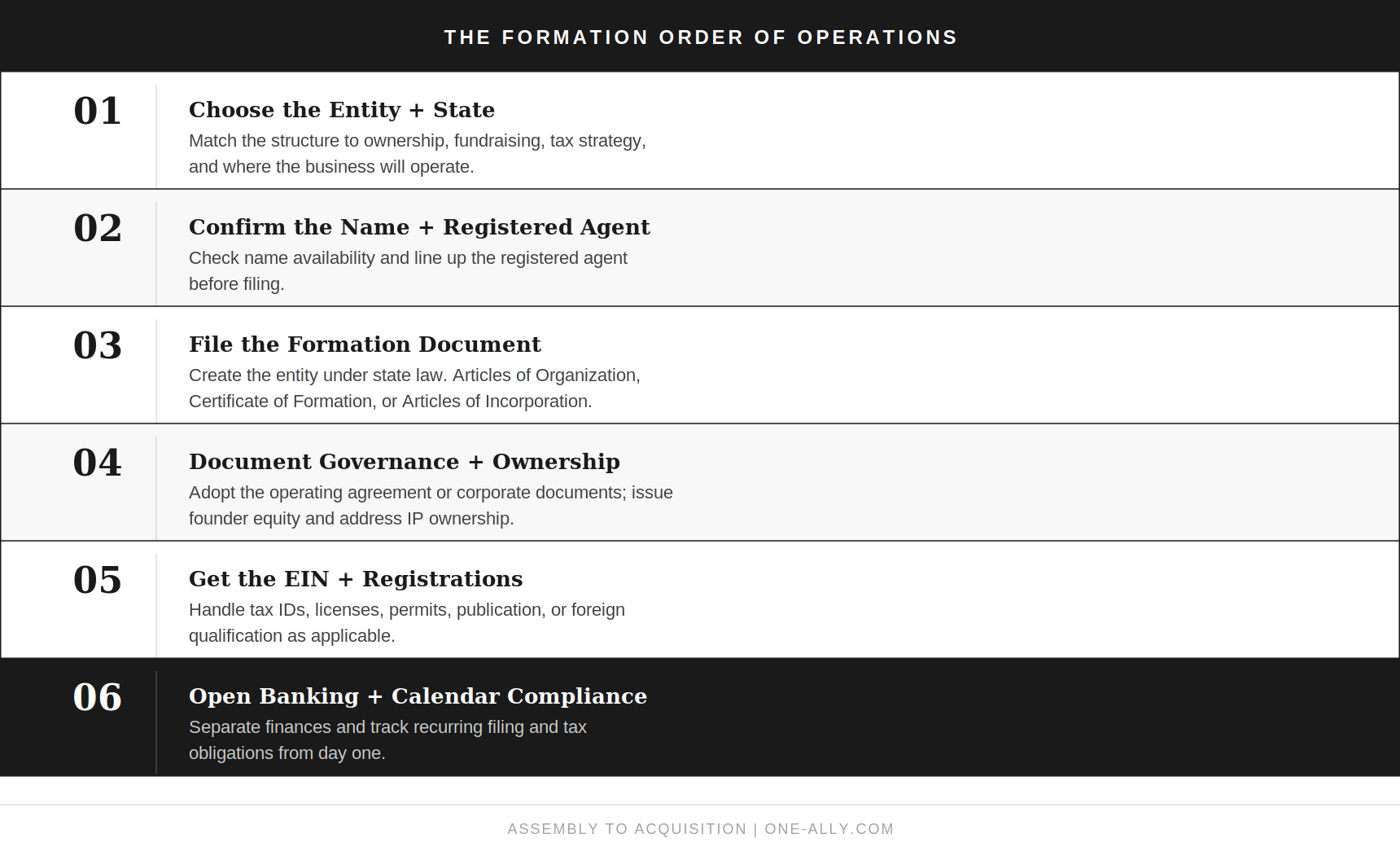
Founder Focused: The Formation Order of Operations
There is no single sequence for every company, but this is a practical starting point for most U.S. founders:
When Is It Worth Bringing in a Lawyer?
A straightforward single-member local business may be able to handle pieces of formation on its own. Counsel becomes more valuable when formation decisions affect ownership, investment, IP, or future transactions. Consider getting advice early if:
• There is more than one founder, especially if roles, equity, vesting, or departures are not fully documented.
• You plan to raise money, issue SAFEs, pursue venture capital, or grant equity to employees or advisors.
• The business depends on IP created by founders, contractors, designers, or developers.
• You are deciding where to form, operating in multiple states, or expect meaningful contracts soon after launch.
Takeaway: Filing Is the Beginning, Not the Finish Line
The goal is not simply to make the government recognize your business. It is to build a company with clear ownership, clear decision-making rules, clean records, separated finances, and a legal foundation that will not need to be rebuilt when an investor, lender, major customer, or buyer shows up.
If you are starting a business and want help getting the foundation right from day one, One Ally would be glad to help you think through the right formation path. Visit www.one-ally.com to schedule a discovery call.
In the next installment of Assembly to Acquisition, we will continue breaking down the legal building blocks founders should have in place as the business moves from formation to growth.
