
What Business Entity Should I Choose and Why Does it Matter?
What Business Entity Should I Choose and Why Does it Matter?
Your entity choice is not just paperwork; it has everyday implications. It affects taxes, liability, fundraising, ownership, and how easy it is to sell your company later. Whether you are just establishing your business model or have a product in the market, figuring out what type of business entity is right for your company is a necessary first step for founders. While a business can change its structure over the course of its growth, having a strong foundation for what you’d like your company to be is critical to ensuring its success. Even though it may seem like a complex and legalistic field decision, the differences in entities are simpler than founders expect.
The Founder's Entity Ladder: From Simple to Scalable
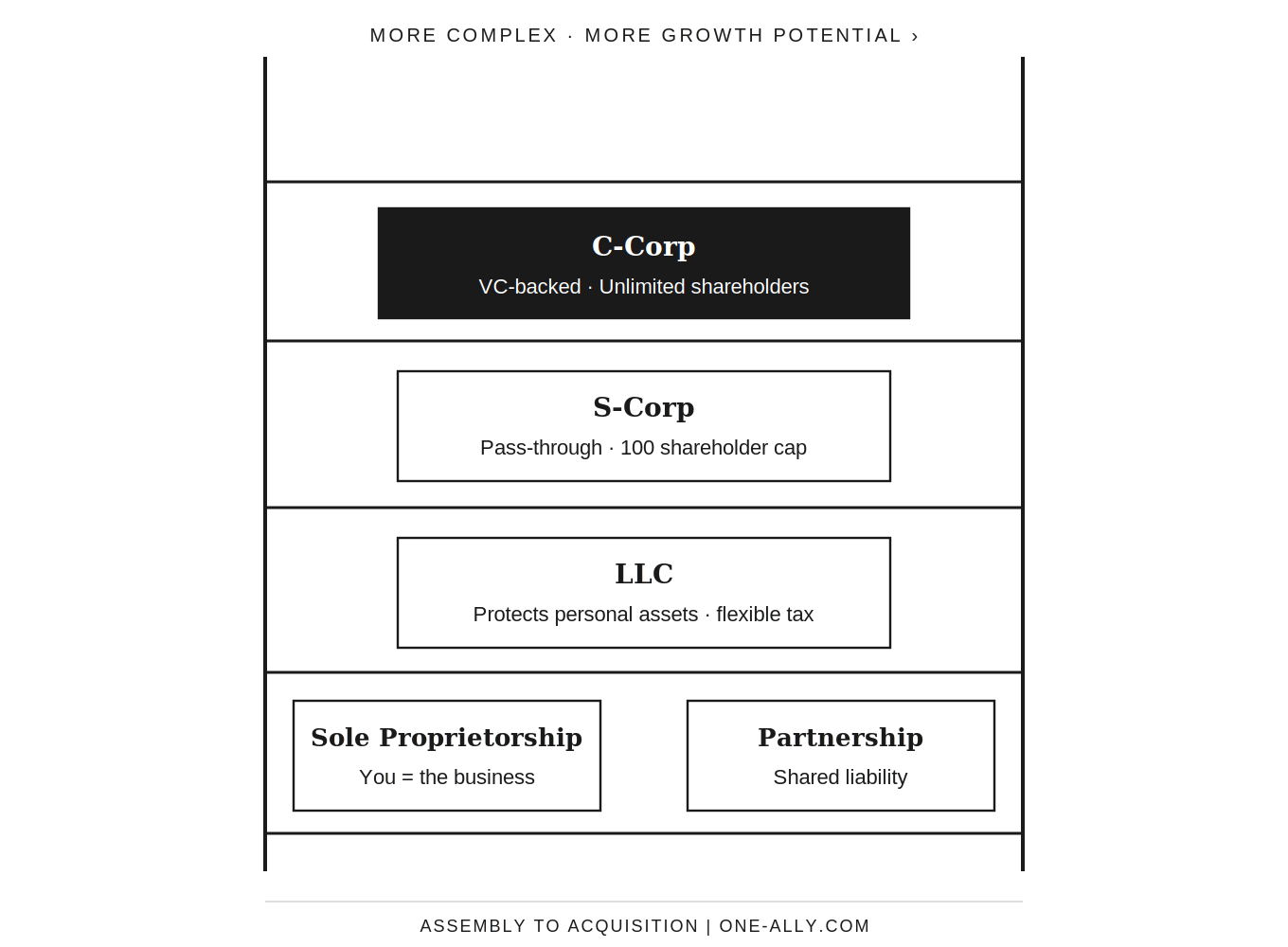
When it comes to differences in legal business entities, it is important to pay attention to nuances, even if they seem unimportant now. It is unfortunate, but not uncommon, that founders regret not doing more research into different business entities before establishing their own, so it is important to consider the differences. The right entity is not always the ‘highest’ one on the ladder; it is the one that matches your risk, tax profile, ownership plan, and growth strategy.
Sole Proprietorship: simple, but no liability shield.
The simplest entity structure is a sole proprietorship. This is good for small local businesses, as the tax filing is easy and it is cheap to set up. This structure establishes you and your business as the same entity, meaning you are responsible for the company's liability and debt. Around the same level is a partnership, which acts the same, but liability is typically shared between the owners. This brings its own benefits, but also the importance of partner equity, which will be discussed in a later post.
LLC: flexible and founder-friendly.
A step up from the sole proprietorship is usually a Limited Liability Company, or an LLC. An LLC separates your company as a separate entity. One important founder note: your legal entity and your tax classification are related, but not always the same thing. For example, an LLC may later elect to be taxed as an S-Corp or C-Corp if that fits the business. This means that your business absorbs liability and debt, which protects your personal assets in the event of your company going under. They are more expensive and difficult to file than a sole proprietorship, and they require annual maintenance. LLCs do not issue corporate stock in the same way corporations do, which can make them less attractive for traditional venture capital financing or a future IPO path unless they later convert into a corporation.
S-Corp: useful for certain profitable closely held businesses.
Further up this ladder are S-Corps, which can be useful for certain closely held businesses, but they come with strict rules: generally no more than 100 shareholders, only eligible shareholders, and only one class of stock. Since S-Corps are considered “pass-through” entities, tax deductions will be directly reflected on your personal income tax. S-Corps can create payroll tax planning opportunities, but they require careful compliance, especially around paying founder-employees reasonable compensation. Usually service and consulting firms of relatively modest size opt in to S-Corp classification because of the reduced self-employment taxes. Professional practice companies as well as family businesses and restaurants usually fall into this category.
C-Corp: built for venture-scale growth.
On the more complex, growth-oriented end of this ladder are C-Corps. C-Corps are generally taxed at the corporate level, and shareholders may also be taxed when profits are distributed as dividends, commonly referred to as double taxation. While that may sound like a drawback, the C-Corp structure can offer significant advantages for companies seeking outside investment, equity incentives, multiple financing rounds, and long-term scalability. C-Corps also provide limited liability and are built for issuing stock, which can make them attractive for companies pursuing venture capital or a future exit.
Here is a quick founder-friendly comparison before we turn to the practical decision points.
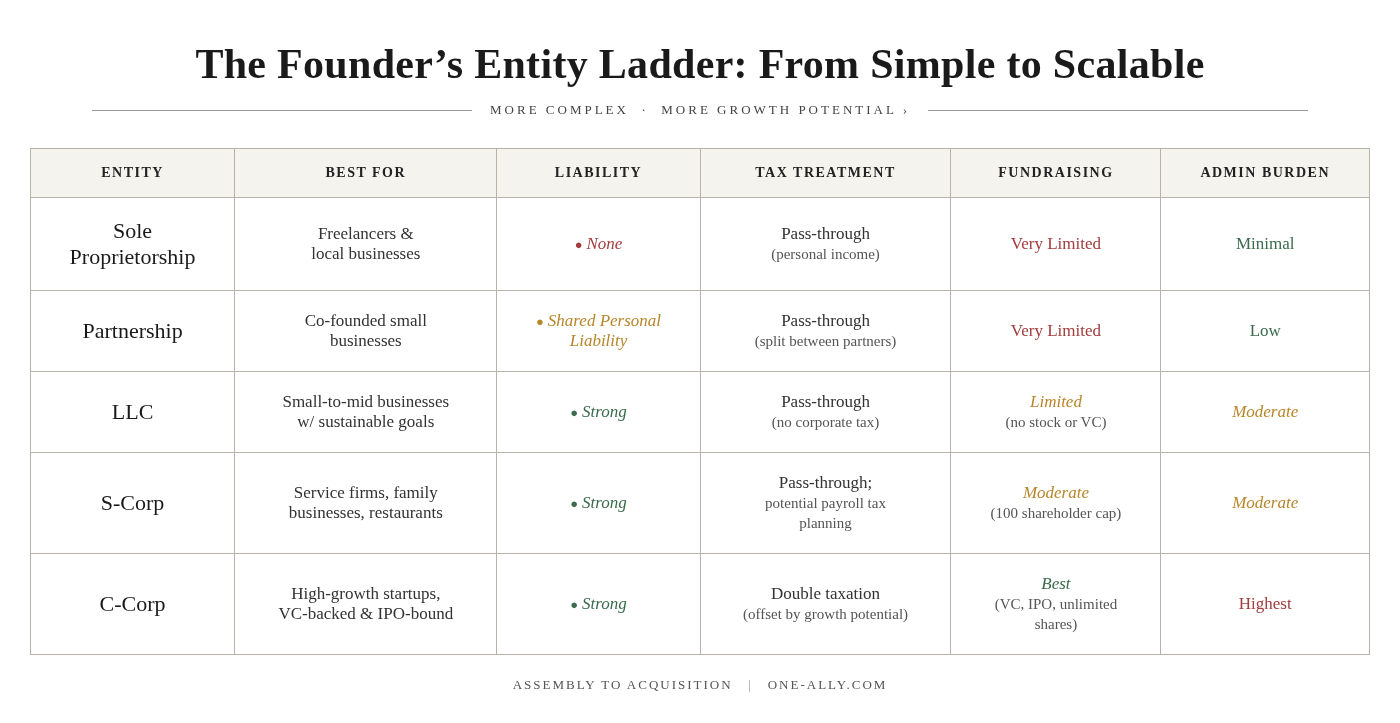
Think of entity choice less as a legal label and more as a growth tool: the right structure should match where your business is today and where you want it to go next. Now we will weigh the potential pros and cons for each of the structures for your business type.
Founder Focused
If you are a founder trying to decide where to begin, we get it: legal entity choices can feel more confusing than helpful. In practice, most founders are usually choosing between two common starting points: an LLC or a C-Corp. Which one is right for you largely depends on your company's vision. Starting your company as an LLC is a smart, level-headed decision that protects your personal assets and gives you room to grow. An LLC is great for a small to medium-sized business that has sustainable growth goals. Some LLCs later elect S-Corp tax treatment, while others convert into C-Corps if the business becomes more fundraising- or exit-oriented. S-Corp taxation is particularly of value if you are a profitable owner-operated business and have tax counsel/accounting support.
On the other hand, if you are confident that your company will be the next huge thing, then your route may be a bit different. High-growth corporations starting as a C-Corp avoid the complexity of pass-through taxation and reap massive investment advantages. While some investors can invest in LLCs, institutional venture capital investors typically prefer Delaware C-Corps because the structure is built for issuing preferred stock, creating option plans, raising multiple financing rounds, and preparing for potential exit. C Corps can also be scaled quickly due to VC backing, as well as unlimited shareholders. That said, C-Corps are complex and expensive, so starting with one certainly carries risks.
Takeaways
Choosing an entity is one of the first real legal decisions a founder makes, and it can shape everything from taxes to fundraising to exit strategy. At One Ally, we help founders build the right legal foundation from day one, with practical guidance that grows with the business. If you are deciding between an LLC, S-Corp election, or C-Corp structure, we would be glad to help you think through the right path. Contact us through OneAlly.com and schedule your free discovery call.
In the next post of Assembly to Acquisition, we’ll continue breaking down the foundational legal decisions that help founders build, protect, and grow their companies.
This post is for general informational purposes only and is not legal or tax advice. The right structure depends on your specific business, ownership, tax, and fundraising goals.
